
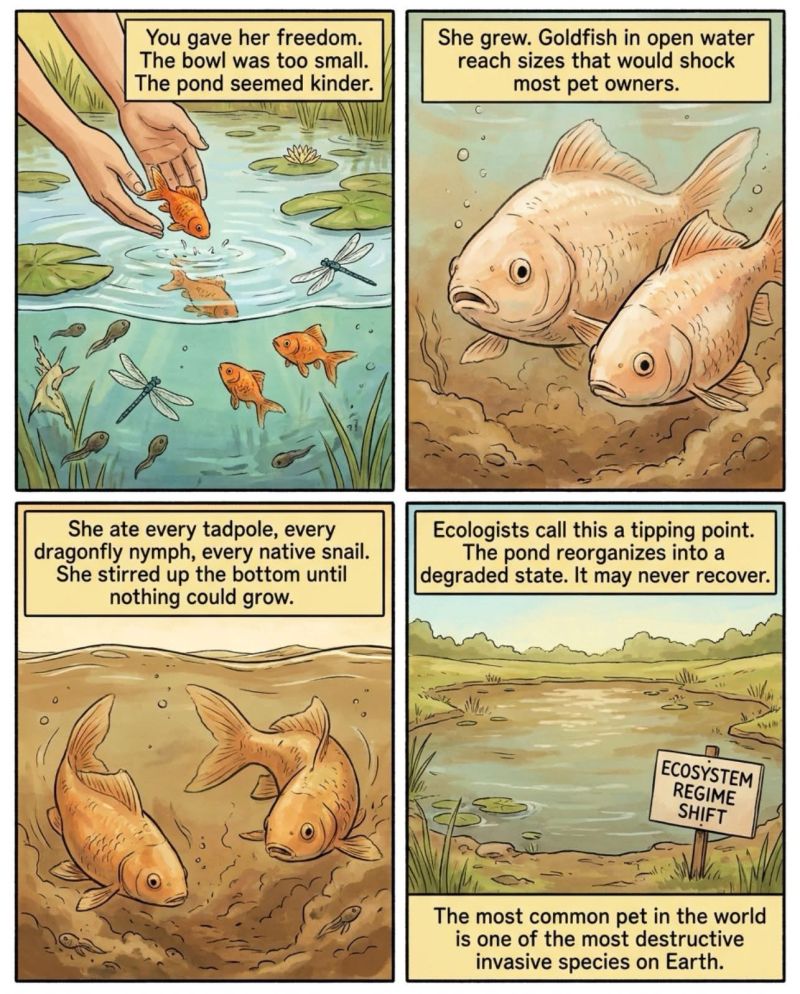
You didn’t want the goldfish anymore. The bowl was too small. The tank was too much work. So you drove to the park, walked to the pond, and gently released her into the water. You felt good. She swam away. You thought you gave her a better life.
You introduced an invasive species that can trigger the collapse of an entire freshwater ecosystem.
A University of Missouri and University of Toledo study published in 2026 in the Journal of Animal Ecology provides some of the strongest experimental evidence to date: released goldfish grow rapidly in natural waters, reaching sizes that would shock most pet owners. They stir up lake sediments, cloud the water, consume massive numbers of native invertebrates, compete with native fish, and in documented cases cause what ecologists call a regime shift — a tipping point where the ecosystem reorganizes into a fundamentally degraded state that is extremely difficult to reverse.
In the US in the Great Lakes region alone, feral goldfish populations are estimated in the tens of millions. The world record feral goldfish weighed nine pounds. The fish you held in your palm can become a football-sized ecological disaster in open water.
Goldfish eat dragonfly nymphs, tadpoles, native fish eggs, snails, and aquatic invertebrates. Every organism they consume was either controlling mosquitoes, pollinating, filtering water, or feeding something native. The pond you “freed” her into is now a degraded system — and it may never fully recover.
If you no longer want a goldfish: return it to the pet store. Give it to another fishkeeper. Contact local wildlife authorities. Do not release it. Not into a pond, a lake, a river, a ditch, or a storm drain.
The most common pet in the world is one of the most destructive invasive species on Earth.