
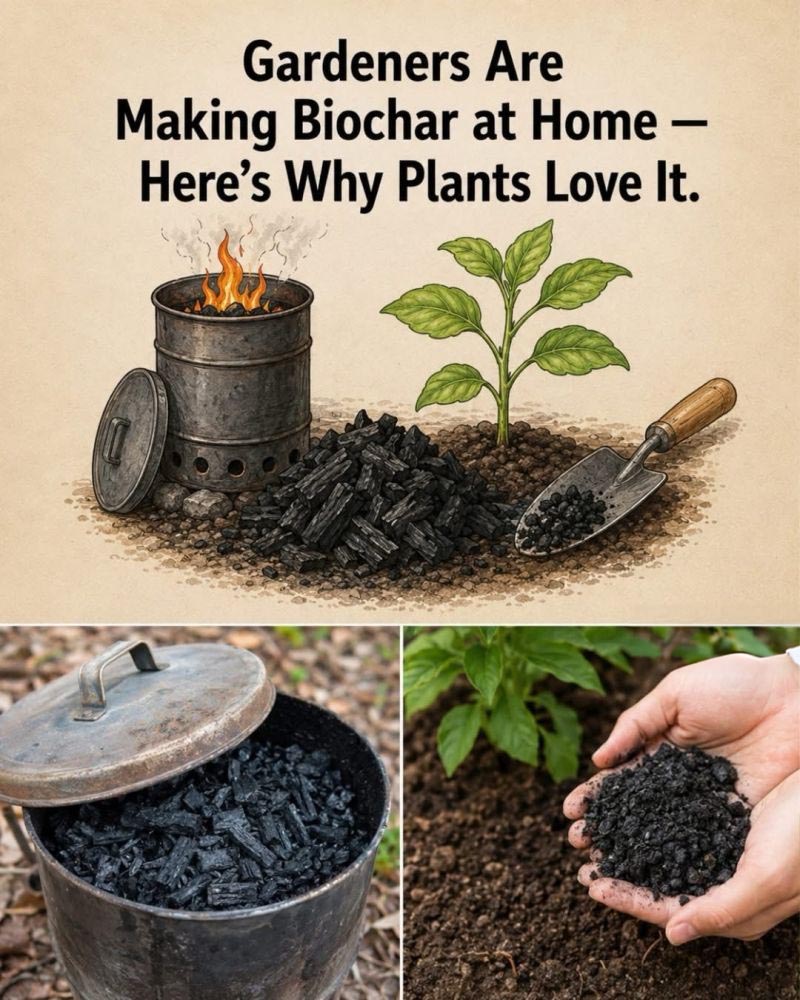
Biochar is one of the most powerful long‑term soil builders you can add to an organic garden. It improves structure, water and nutrient holding, supports microbes, and locks carbon into the soil for decades or longer, making it good for plants and the climate at the same time.
What biochar is
Biochar is a highly stable, charcoal‑like form of carbon made by heating organic material (wood, crop residues, manures) in low‑oxygen conditions, a process called pyrolysis.
Unlike ordinary charcoal or ash, good biochar is:
•Very porous, with huge internal surface area.
•Long‑lasting in soil (hundreds to thousands of years in some cases).
•Typically inert by itself, but excellent at holding water, nutrients and microorganisms.
It’s recognised as an allowed soil amendment in certified organic systems in many places.
Benefits for soil structure
Biochar acts like a permanent “sponge” in the soil:
•It improves aggregation and porosity, helping compact or heavy soils loosen up and sandy soils hold shape.
•Its porous structure enhances aeration around roots, reducing the risk of waterlogging and root diseases in poorly structured soils.
•In trial plots, soils amended with biochar show higher cation‑exchange capacity (CEC), meaning more sites for nutrients to cling to and be available to plants.
For an organic gardener, that means deeper, healthier root systems and a soil that’s easier to work without constant tilling.
Water retention and drought resilience
One of biochar’s biggest practical benefits is water management:
•In sandy, low‑organic soils, biochar greatly increases water‑holding capacity, reducing how fast water drains away and is lost to deep leaching.
•Its pores store moisture and release it slowly back to surrounding soil, buffering plants against dry spells.
•Garden trials show that beds with biochar often need less frequent watering, especially in light soils and hot climates.
For organic gardeners trying to conserve water or cope with hotter, drier seasons, this can be a major advantage.
Nutrient retention and fertilizer efficiency
Biochar doesn’t contain many nutrients itself, but it changes how soil holds and cycles them:
•It binds and retains nutrients like nitrogen, potassium and others that might otherwise leach out, especially in sandy or degraded soils.
•Studies combining biochar with organic manures or compost show improved soil fertility, better root function, and higher yields compared to manure alone, because nutrients are held in the root zone for longer.
•By reducing nutrient losses, biochar can lower the amount of fertiliser you need, which fits perfectly with low‑input organic gardening.
In practice, that means more of the nitrogen and potassium from your compost or organic feed is actually used by plants instead of washing away.
Microbial life and disease suppression
Healthy organic gardens depend on rich soil biology. Biochar supports this by:
•Providing protected “habitat” in its pores for bacteria, fungi and other microorganisms.
•Helping beneficial microbes colonise and persist, which supports nutrient cycling and plant health.
•In some trials, biochar‑amended soils show reduced incidence of certain soil‑borne diseases (such as damping‑off and root rots), likely due to improved microbial balance and better structure.
Because organic systems rely on biological rather than chemical control, this improvement in the soil food web aligns strongly with organic principles.
Long‑term stability and climate benefits
Unlike compost, which breaks down in a few years, biochar is extremely stable:
•Ancient “terra preta” soils in the Amazon still show high fertility and dark colour from biochar added thousands of years ago.
•Once in the soil, biochar locks carbon away for centuries to millennia, making it a form of carbon sequestration.
•Producing biochar via modern pyrolysis can be carbon‑neutral or even carbon‑negative, especially when the process captures heat or gases as renewable energy.
For organic gardeners concerned about climate change as well as soil health, biochar offers a way to build long‑term fertility while also reducing atmospheric CO₂.
How to use biochar in an organic garden
A key concept is “charging” biochar:
•Fresh biochar is highly adsorptive; if added alone, it can temporarily soak up nutrients and water that plants might otherwise use.
•Mixing it with compost, worm castings, aged manure or nutrient‑rich soil and moistening it before application fills its pores with life and nutrients.
Practical application methods:
•In beds: Mix charged biochar into the top 10–15 cm of soil; rates vary, but many small‑scale guides suggest starting with 5–10% of the volume in problem areas (very sandy or depleted soils).
•Top‑dressing: Blend with compost and spread as a 1–2 cm layer annually, then lightly incorporate.
•In potting mixes: Use biochar to partly replace perlite or vermiculite for better water retention and drainage, especially for seedlings and container crops.
The advantage for organic gardening is that, once built into the soil, biochar doesn’t need frequent reapplication—its effects are long‑lasting.
Limitations and considerations
Biochar isn’t a magic fix, and it has some caveats:
•Benefits are most dramatic in poor, sandy, acidic or heavily degraded soils; in already rich, high‑organic soils, the improvement may be modest.
•Some field trials show more gains in soil properties than in immediate plant growth; effects on yield can depend on crop type, soil conditions, and how biochar is prepared and applied.
•Quality and cost vary; high‑quality biochar can be relatively expensive for large areas, so many gardeners start with small test plots or focus on their most stressed beds.
Organic gardeners get best results when biochar is part of an integrated approach: compost, mulches, rotations, cover crops, and minimal disturbance, with biochar added to make those improvements more durable.
Why biochar fits organic principles
Biochar complements organic gardening because it:
•Builds soil life and structure rather than relying on synthetic inputs.
•Makes better use of organic waste materials (prunings, crop residues, manures) by converting them into stable soil carbon instead of letting them release CO₂ as they rot.
•Reduces fertiliser needs and nutrient pollution, while helping gardens cope with heat and drought.
If you’re gardening organically in Australia, especially on sandy or tired soils, carefully charged biochar can be a long‑term investment in soil health. Starting with a single bed or a section of your veg patch lets you see how it behaves in your conditions before scaling up.