
Organic sweet potatoes are one of the easiest and most rewarding warm‑season crops: they thrive in heat, enrich the garden with lush vines, and store well for months if cured properly.
Understanding sweet potatoes
Sweet potatoes (Ipomoea batatas) are a tropical vine grown for their swollen storage roots, not true tubers like regular potatoes. They:
•Need a long, warm growing season (about 90–120 frost‑free days).
•Prefer full sun, loose soil, and steady moisture.
•Are propagated from “slips” (sprouted cuttings), not seeds.
In warm parts of Australia, including much of New South Wales, they can do very well outdoors; in cooler regions, they may need protection (raised beds, plastic, tunnels).
Choosing varieties for organic gardens
Different varieties suit different climates and tastes:
•Orange‑fleshed types (e.g. Beauregard, Orleans)
•High in beta‑carotene.
•Reliable yields and good storage.
•Purple‑ or white‑fleshed types
•Often slightly drier or more “chestnut‑like” in texture.
•Can be excellent roasted or in savoury dishes.
For organic growing:
•Choose disease‑resistant varieties recommended for your region.
•Buy certified organic slips or root stock from reputable nurseries or local growers to avoid pesticide residues and storage sprout inhibitors.
Preparing soil organically
Sweet potatoes love:
•Well‑drained, loose soil so roots can swell easily.
•Slightly acidic pH around 5.5–6.5.
•Moderate fertility, with good phosphorus and potassium, but not too much nitrogen.
Organic soil preparation:
•Add plenty of compost, well‑rotted manure, or aged leaf mould to improve structure and life.
•Avoid fresh manure at planting time; it can cause excessive foliage and split roots.
•Create raised beds or mounded ridges 15–20 cm high for drainage and root expansion.
•If your soil is heavy clay, incorporate coarse sand or grow in deep raised beds.
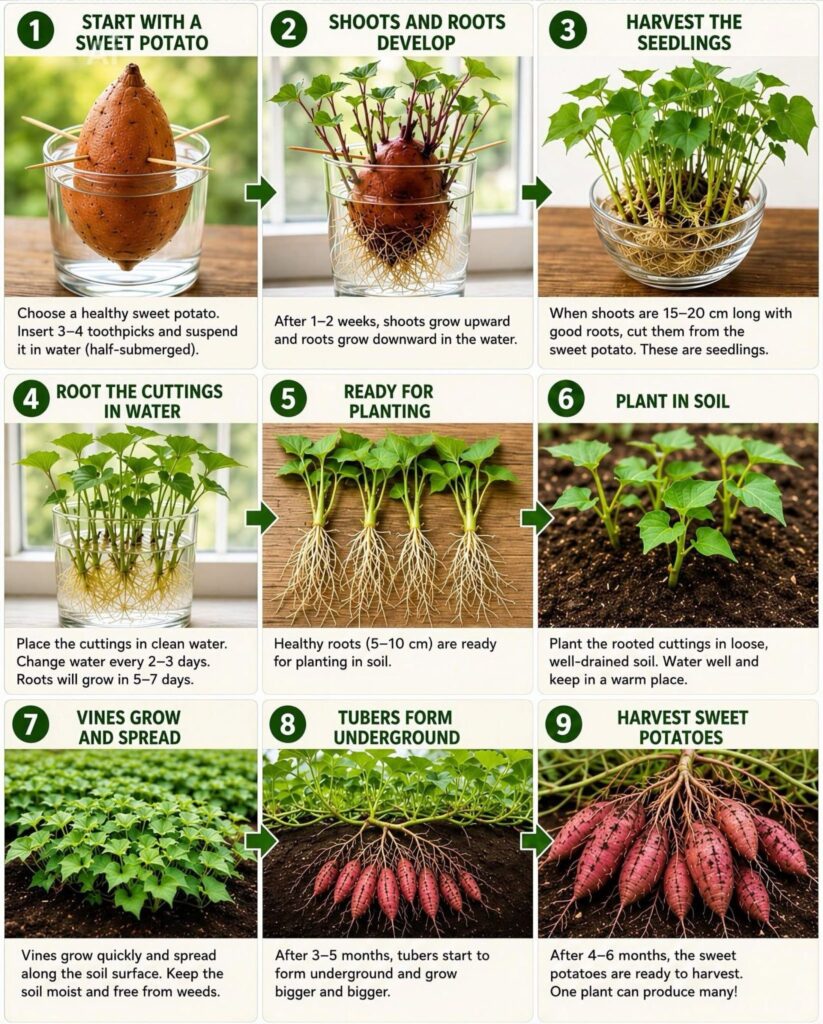
Producing and handling slips
You can either buy slips or produce your own:
1.Make your own slips from organic roots
•About 6–8 weeks before planting, place sound, unblemished sweet potatoes half‑buried in moist sand, compost, or a tray of potting mix in a warm spot.
•Keep the medium moist (not waterlogged) and warm (around 24–27 °C).
•Shoots (“slips”) will emerge from the root; once they reach 15–20 cm long, gently twist or cut them off.
2.Root the slips
•Place slips into moist potting mix, or a jar of water, until they develop fine roots.
•Keep warm and in bright, indirect light.
3.Buying slips
•When buying, plant them soon after arrival.
•If they look a bit wilted, trim any damaged leaves and hydrate them gently until they perk up.
Planting time and spacing
Sweet potatoes are very frost‑sensitive:
•Plant 2–4 weeks after your last expected frost, once the soil is consistently warm (at least 18 °C; warmer is better).
•In cooler districts, pre‑warm soil with black plastic or fabric, or plant under cloches/low tunnels.
Planting guidelines:
•Space slips 30–40 cm apart in rows 75–90 cm apart.
•Bury them deeply enough to cover several nodes on the stem (often up to the first set of leaves), which encourages more root formation.
•Water well at planting to settle soil around roots.
Watering and feeding organically
Sweet potatoes need:
•Consistent moisture
•Keep soil evenly moist for the first few weeks to help slips establish.
•Once established, aim for about 2–3 cm of water per week (rain plus irrigation).
•Avoid waterlogging—roots can rot in saturated soil.
•Balanced organic nutrition
•Before planting, incorporate compost and, if needed, rock phosphate or bone meal for phosphorus, and sulphate of potash or wood ash (sparingly) for potassium.
•Go easy on high‑nitrogen inputs; too much nitrogen makes masses of vines but few roots.
•A light top‑dressing of compost or a gentle organic fertiliser midway through the season is usually enough.
As harvest approaches (last 3–4 weeks), gradually ease off heavy watering to reduce risk of cracking and to help skins set.
Organic weed and vine management
•Weed early and often while plants are small; once vines cover the soil, they shade out most weeds.
•Use organic mulches (straw, hay, leaf litter) after the soil has warmed to suppress weeds and conserve moisture.
•Occasionally lift or reposition vines so they don’t root everywhere along the stems, which can produce many small, scattered roots instead of a good cluster at the plant’s base.
Common pests and diseases (and organic control)
Key threats vary by region, but common issues include:
•Soil insects
•Wireworms, grubs, and root‑feeding beetle larvae can scar roots.
•Rotate crops; avoid planting sweet potatoes after lawns or sod; encourage birds and beneficial soil life.
•Nematodes
•Choose resistant varieties and practice long rotations (3–4 years) before replanting sweet potatoes in the same bed.
•Add organic matter and use cover crops that suppress nematodes (e.g. marigolds, certain mustards).
•Fungal rots and leaf spots
•Avoid prolonged water on leaves and overly wet soils.
•Provide good airflow and don’t overcrowd plants.
•Remove and destroy heavily diseased foliage; keep beds tidy of old vines and debris after harvest.
General organic strategies:
•Maintain diverse planting and healthy soil life.
•Use crop rotation and companion planting where practical.
•Consider physical barriers (mesh, row covers) for severe pest problems.
Harvesting at the right time
Sweet potatoes are usually ready:
•When vines start to yellow and growth slows, or
•After your expected days‑to‑maturity for the variety (often 90–120 days).
Harvest tips:
•Aim to dig before the first hard frost; light frost may burn leaves, but cold soil can damage roots.
•Use a fork or shovel 20–30 cm away from plants to avoid spearing roots.
•Lift gently; sweet potatoes bruise easily and skins are quite tender when first dug.
•Do not wash roots at harvest; brush off loose soil instead.
Curing and storing organically
Curing improves flavour and storage:
•Cure freshly dug roots for about 1–2 weeks in a warm, humid spot: around 27–30 °C with good air circulation and reasonably high humidity.
•This allows skins to toughen and converts some starches to sugars.
•After curing, store at:
•About 12–18 °C in a dry, dark, well‑ventilated place.
•Avoid refrigeration; cold storage damages sweet potatoes and can cause off flavours.
Properly cured and stored sweet potatoes can last several months, often through most of the winter.
Saving stock for next season
For organic continuity:
•Select the healthiest, best‑shaped roots from your harvest to use as “seed” for making slips next year.
•Store them carefully so they remain sound until it’s time to sprout them again.
•Over a few seasons, you’ll naturally select varieties and individual plants that perform best in your soil and climate.
Example organic growing plan (temperate, warm summer)
1.Late summer–autumn: Build a new raised bed; add compost and mulch.
2.Late winter: Test soil pH; plan mild amendments if needed.
3.Early–mid autumn (Southern Hemisphere): Start slips indoors from saved organic roots.
4.After last frost, once soil is warm: Plant rooted slips into raised beds, mulch and water.
5.Through the season: Keep weeds out early, water regularly, lift sprawling vines occasionally.
6.Early–mid spring: Harvest as vines yellow, cure roots, then store for winter eating and next year’s slips.