
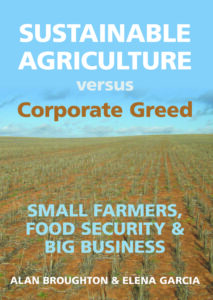
Sustainable Agriculture versus Corporate Greed: SmallFarmers, Food Security & Big Business by Alan Broughton and Elena Garcia. Resistance Books, 2017.
Description
Across the world, agriculture — on which all human life depends — is under sustained attack by big business.
Small farmers are everywhere being forced off the land and replaced by big corporate outfits whose sole aim is profit maximisation. The industrial farming practiced by agribusiness is marked by land degradation and heavy use of insecticides, herbicides and fertilisers. Agribusiness is also a big contributor to greenhouse gas emissions.
But contrary to the myths spread by big business apologists, the evidence shows that family farms are many times more productive and better cared for than large holdings.
Author Alan Broughton makes an incisive survey of the ills of neoliberal agriculture and highlights the alternatives. Several articles by Elena Garcia focus specifically on Australia and the battle for an agricultural system not dominated by the giant corporations.
This is a primer on what’s wrong with corporate profit-centred agriculture and the fight for a people-centred alternative.
___________________
This book examines the social and ecological issues associated with large-scale farming, including land ownership, economies of scale, the increasing size of farm enterprises, and the resulting pressures on family farming.
Alan Broughton is responsible for the first section, an introduction to the economic and social issues of western, industrial agriculture. The production efficiency of large farms is questioned and found to hold true only for labour efficiency. Small farms can apply methodologies such as long rotations, multi-cropping and other agroecological approaches to produce more food per hectare than large farms.
Elena Garcia is responsible for the second part, which discusses ecological and social issues in Australian agriculture, including the role of animal agriculture in contributing to global warming, and how animal breeding and better diets may reduce their impact.
The authors then propose a manifesto for sustainable agriculture in Australia. Their suggestions include government support for small farms, reform of intensive animal industries, protection of water quality, and withdrawal from the WTO.
The book maintains an agroecological approach and covers topics such as human rights for rural people, including rights to food, water, employment, housing, education, health care, communication, rest and culture.
Garcia and Broughton offer a significant criticism of industrial agriculture and a very useful introduction to alternative agricultural policy.