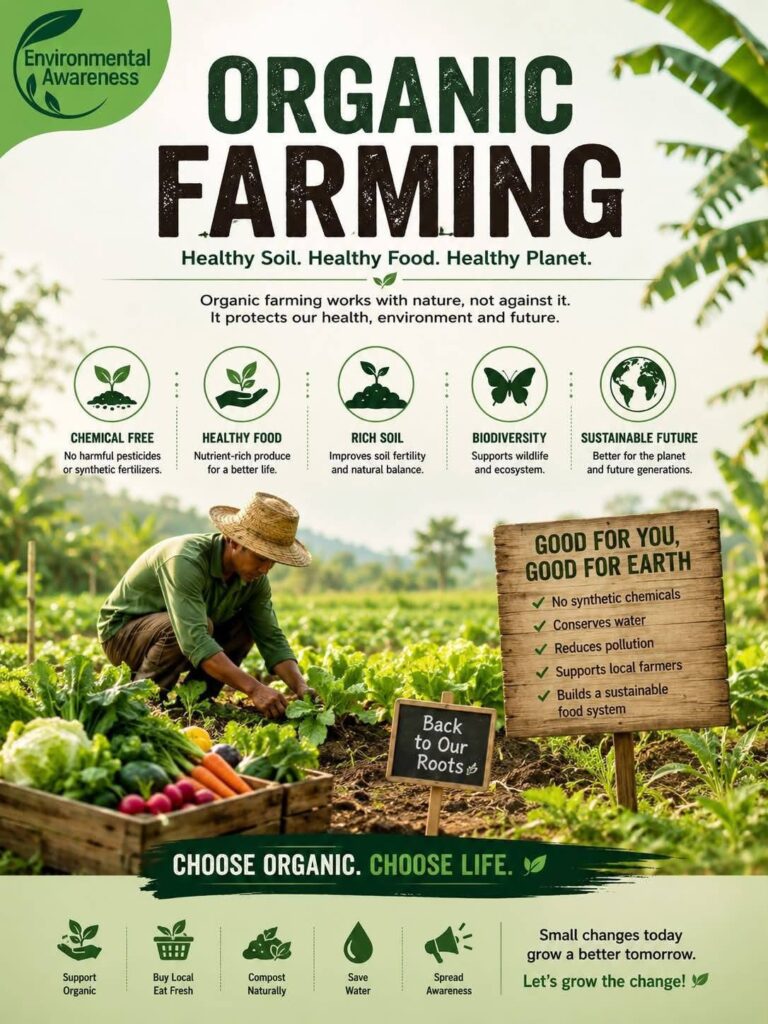
The way we grow our food has consequences far beyond the farm gate. Agriculture influences the quality of the food we eat, the health of our soils and waterways, biodiversity, greenhouse gas emissions and the resilience of communities to a changing climate.
Organic farming offers an alternative approach based on a simple principle:
work with natural biological systems rather than relying heavily on synthetic chemical inputs.
Organic agriculture is not perfect, nor is every organic farming system automatically more sustainable than every conventional one. But when good organic practices are combined with crop rotation, composting, biodiversity, careful water management and responsible soil stewardship, they can provide important benefits for both human health and the environment.
Reducing Exposure to Synthetic Pesticides
One of the clearest personal benefits of choosing organically produced food is reduced exposure to many synthetic pesticide residues.
Conventional farmers use pesticides to protect crops from insects, weeds and diseases. Governments establish residue limits designed to keep exposure within acceptable safety levels, and food containing a detectable pesticide residue is not therefore automatically dangerous.
Nevertheless, organic farming greatly restricts the use of most synthetic pesticides. Research has consistently found that people who switch to organic diets generally have lower measurable exposure to a number of commonly used pesticides.
This can be particularly appealing to families who want to minimise unnecessary chemical exposure while continuing to eat plenty of fresh fruit and vegetables.
Importantly, organic does not mean completely pesticide-free. Organic farmers can use certain approved pesticides, and all farming requires responsible pest management.
Nutritious Food Begins with Healthy Soil
Organic farming places enormous emphasis on
soil health.
Instead of treating soil simply as a medium for holding plants upright while soluble fertilisers supply nutrients, good organic farming treats soil as a living ecosystem.
Compost, animal manures, green manures, legumes, crop rotations, mulches and cover crops feed soil organisms and recycle nutrients. Earthworms, fungi, bacteria and countless other organisms help decompose organic matter and make nutrients available to plants.
Some research has found nutritional differences between organic and conventionally produced foods, including differences in certain antioxidants and fatty acids, although these differences vary considerably between foods and farming systems.
The strongest reason for eating fruit, vegetables, whole grains, legumes, nuts and seeds remains their overall nutritional value—not simply whether they carry an organic label.
Protecting the Life Beneath Our Feet
Healthy soil is one of civilisation’s most valuable resources.
Yet agricultural soils can be degraded through erosion, excessive cultivation, loss of organic matter, salinity, compaction and poor land management.
Organic systems commonly encourage practices such as crop rotation, cover cropping, composting and returning organic matter to the land. These practices can improve soil structure, biological activity and water-holding capacity.
A soil rich in organic matter acts like a sponge. It can absorb more rainfall, retain moisture during dry periods and reduce erosion and runoff.
Building soil is therefore not merely about producing next season’s crop. It is an investment in the ability of future generations to feed themselves.
Cleaner Rivers, Creeks and Groundwater
What happens on a farm does not necessarily stay on the farm.
Rain can carry soil, nutrients and agricultural chemicals into drains, creeks, rivers and eventually the ocean. Excessive nutrient losses can contribute to water pollution, while some pesticides can affect aquatic organisms and other wildlife.
Organic farming seeks to minimise reliance on synthetic fertilisers and pesticides while building fertility through biological processes.
Careful organic management can therefore form part of a broader strategy for protecting waterways—but organic farms must still manage manure, nutrients, erosion and runoff responsibly.
Creating Space for Biodiversity
A productive farm does not have to be a biological desert.
Hedgerows, flowering plants, shelterbelts, native vegetation and diverse crops can provide habitat for bees, butterflies, birds, predatory insects and other wildlife.
Many of these creatures actually help farmers.
Bees and other insects pollinate crops. Predatory insects consume pests. Birds, frogs, spiders and other animals form part of complex ecological systems that can naturally regulate pest populations.
Organic farming generally encourages greater biological diversity rather than attempting to eliminate every organism except the crop being harvested.
🐝
A healthy farm should produce food while remaining part of a living ecosystem.
Building Resilience to Climate Change
Agriculture faces an increasingly difficult future of heatwaves, droughts, floods and unpredictable weather.
Healthy soils containing substantial organic matter can improve water infiltration and moisture retention, helping farms cope with both heavy rainfall and dry conditions.
Organic and regenerative practices such as cover cropping, reduced soil disturbance, agroforestry and diverse rotations can also contribute to storing carbon in soils and vegetation.
The climate impact of farming, however, is complicated. Organic farms sometimes produce lower yields for particular crops, meaning more land may be required to produce the same amount of food. Sustainable agriculture therefore needs to consider productivity as well as environmental performance.
The goal should not simply be an agricultural label.
The goal should be
productive farms that regenerate rather than exhaust the natural resources upon which agriculture depends.
Reducing Dependence on External Inputs
Modern industrial agriculture can depend heavily on manufactured fertilisers, pesticides, fossil fuels and globally traded inputs.
Organic farming attempts to close more of the nutrient cycle locally.
Compost becomes fertiliser. Crop residues return to the soil. Legumes capture atmospheric nitrogen. Beneficial insects assist pest control. Seeds can be saved where suitable varieties are used.
The more fertility a farm can generate biologically, the less vulnerable it may become to disruptions in international fertiliser and chemical markets.
This principle is equally powerful in the home garden.
A household that composts kitchen scraps, saves seeds, grows herbs and vegetables, captures water and builds healthy soil is transforming waste into fertility and dependence into resilience.
Organic Farming Is About Future Generations
Perhaps the greatest benefit of organic agriculture cannot be measured in a single tomato, paddock or harvest.
It is about
what we leave behind.
Every generation inherits soil, water, seeds, biodiversity and agricultural knowledge from those who came before it. We have a responsibility not merely to use those resources but to pass them forward in good condition.
Imagine an agricultural future built around living soils, diverse farms, cleaner waterways, thriving pollinator populations, reduced unnecessary chemical use and communities capable of producing nutritious food locally.
Organic farming alone cannot solve every environmental or health problem. Nor should debates about agriculture become a simplistic battle between “organic” and “conventional” farmers. Farmers operate under enormous economic, climatic and practical pressures, and many conventional growers are already adopting techniques associated with organic and regenerative agriculture.
The important question is
which farming practices move us towards healthier people and healthier ecosystems?
We can all contribute.
Grow some food organically. Compost household organic waste. Support local farmers. Buy organic when practical. Reduce food waste. Save seeds. Plant flowers for pollinators. Learn where your food comes from and teach children that food begins not in a supermarket, but in soil.
Ultimately, human health and environmental health are inseparable.
Healthy soil grows healthy food. Healthy landscapes support healthy communities. And the decisions we make about agriculture today will help determine what kind of planet our children inherit tomorrow.
🌱
Feed the soil. Protect biodiversity. Grow good food. Farm for the future.