The Dirty Dozen: Which Fruits and Vegetables Have the Most Pesticide Residues?
Every year, millions of people choose fresh fruit and vegetables because they want to improve their health. But alongside the nutritional benefits of fresh produce comes a question increasingly asked by consumers:
How much pesticide residue is left on our food?
One of the best-known attempts to answer this question is the **Dirty Dozen**, an annual list published by the US-based Environmental Working Group (EWG). It identifies conventionally grown fruits and vegetables that, according to EWG’s analysis of US government testing data, tend to have comparatively high levels or frequencies of detectable pesticide residues.
The list has become popular among consumers deciding which foods they might prefer to buy organically.
What Is the Dirty Dozen?
The Dirty Dozen is not a list of foods officially declared dangerous or unsafe.
Instead, EWG analyses pesticide-residue testing conducted by US government agencies and ranks produce using factors such as the proportion of samples containing detectable pesticides, the number of different pesticides detected and the concentrations reported.
The exact ranking can change from year to year.
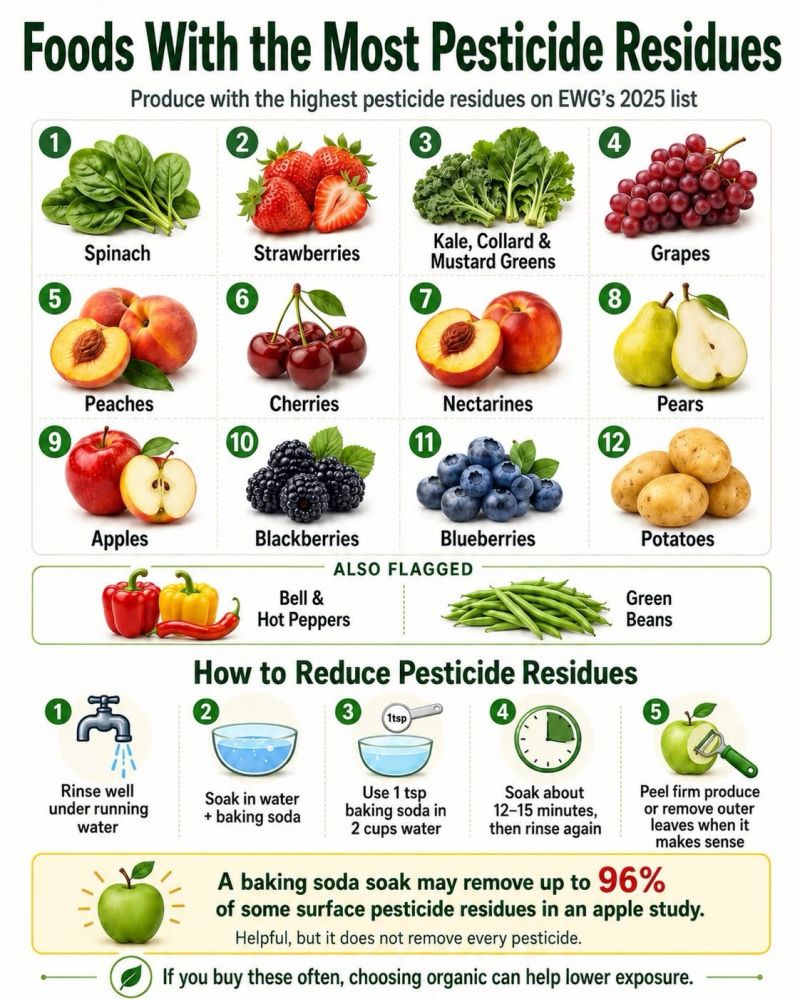
Produce that has commonly appeared on recent Dirty Dozen lists includes:
🍓 **Strawberries**
🥬 **Spinach**
🥬 **Kale and other leafy greens**
🍇 **Grapes**
🍑 **Peaches**
🍐 **Pears**
🍎 **Apples**
🌶️ **Capsicums and hot peppers**
🍒 **Cherries**
🫐 **Blueberries**
🫘 **Green beans**
Other produce may enter or leave the twelve positions as testing results and EWG’s methodology change.
Why Are Pesticides Used?
Farmers face a constant battle against insects, weeds, fungi and plant diseases. Conventional agriculture uses herbicides, insecticides and fungicides as part of managing these threats and protecting crop yields.
Following application, tiny quantities of a pesticide or its breakdown products can sometimes remain on or within harvested produce.
These are known as ‘pesticide residues’.
Regulators establish maximum residue limits for pesticides in food, and produce containing detectable residues is not automatically unsafe. The amount of a chemical and the level and duration of exposure are fundamental to determining risk.
This distinction is important because the Dirty Dozen measures aspects of ‘pesticide presence rather than directly measuring the health risk of eating each food’.
Why Is the List Controversial?
The Dirty Dozen attracts criticism from food scientists, agricultural organisations and regulators because simply detecting a pesticide does not establish that the amount present represents a meaningful health risk.
Modern analytical equipment can detect extraordinarily small quantities of chemicals.
A food containing traces of several pesticides is therefore not necessarily more dangerous than a food containing one pesticide. Toxicity, concentration and human exposure all matter.
EWG takes a more precautionary position, arguing that consumers who want to reduce their pesticide exposure can use its rankings when deciding which foods to purchase organically.
These perspectives are not necessarily contradictory.
Government residue limits are designed to protect consumers, while an individual may still reasonably decide that they want to reduce unnecessary pesticide exposure.
The Dirty Dozen Is an American List
This is particularly important for Australian consumers.
The Dirty Dozen is based primarily on ‘produce sampled in the United States and US pesticide-use patterns and regulations’.
Australian farming practices, approved pesticides, climate, imported-food sources and regulatory requirements differ.
Therefore, an American Dirty Dozen ranking should not simply be presented as a scientifically established ranking of Australian fruit and vegetables – but it’s a valuable alert as to what we should be awware of , because chemical farming has a lot in common across the globe.
For Australians, information from Food Standards Australia New Zealand and Australian residue-monitoring programs provides more locally relevant evidence about pesticide residues in our food supply.
Does Organic Produce Have No Pesticides?
No.
One common misconception is that “organic” automatically means “pesticide-free.”
Certified organic farming prohibits or restricts many synthetic pesticides but permits certain pest-control products. Organic produce can also occasionally contain residues resulting from environmental contamination, previous land use or spray drift from neighbouring farms.
The important difference is that organic agriculture generally aims to manage pests through biological diversity, crop rotation, healthy soils, beneficial insects and other preventative approaches while greatly restricting the synthetic pesticides available to conventional agriculture.
Choosing organic food can therefore reduce exposure to many synthetic pesticide residues, although it does not guarantee that every item contains zero pesticide residue.
Can You Wash Pesticides Off?
Washing fruit and vegetables under clean running water is worthwhile.
It can remove soil, microorganisms and some pesticide residues present on the surface. Peeling can further reduce certain residues, although valuable fibre and nutrients can also be lost.
But washing cannot necessarily remove everything.
Some pesticides are systemic, meaning they can be absorbed by the plant and occur within its tissues. Others may bind strongly to the surface.
This is why washing produce is good practice but should not be regarded as a guarantee of removing all pesticide residues.
Should You Avoid Dirty Dozen Foods?
No.
This is perhaps the most important message.
**Don’t stop eating strawberries, spinach, apples, grapes or other nutritious fruit and vegetables because you are worried about pesticides.**
The health benefits associated with diets rich in fruit and vegetables are substantial.
If organic food is available and affordable, someone wishing to minimise pesticide exposure might choose organic versions of produce that frequently carries residues. If organic produce isn’t affordable, conventionally grown fruit and vegetables remain an important part of a healthy diet.
The Dirty Dozen should therefore be viewed as a ‘shopping guide for people interested in reducing pesticide exposure—not a list of foods that are poisonous or should be avoided.’
Grow Your Own
There is another option that gives you considerably more control over how your food is produced:
Grow it yourself.
Strawberries, leafy greens, tomatoes, capsicums, beans and many herbs can be grown organically in surprisingly small spaces.
By building healthy soil, making compost, encouraging beneficial insects, rotating crops and using physical and biological pest controls, home gardeners can produce fresh food while greatly reducing their reliance on synthetic pesticides.
You also gain something no supermarket label can completely provide: direct knowledge of how your food was grown.
A Better Way to Think About Food
The real lesson behind the Dirty Dozen is not that we should become frightened of fresh produce.
It is that we should become **better informed about how our food is produced**.
Ask questions. Buy locally when possible. Support farmers who minimise unnecessary pesticide use. Choose organic when it makes sense for your household. Wash fresh produce. Grow some of your own food. And above all, continue eating a diverse range of fruits and vegetables.
Our goal should not be fear of food.
It should be an agricultural system capable of producing abundant, nutritious food while reducing unnecessary chemical use and protecting the farmers, consumers, soil, water, pollinators and ecosystems upon which our food supply ultimately depends.
🌱 Know your food. Know how it was grown. Support better farming. Grow what you can.